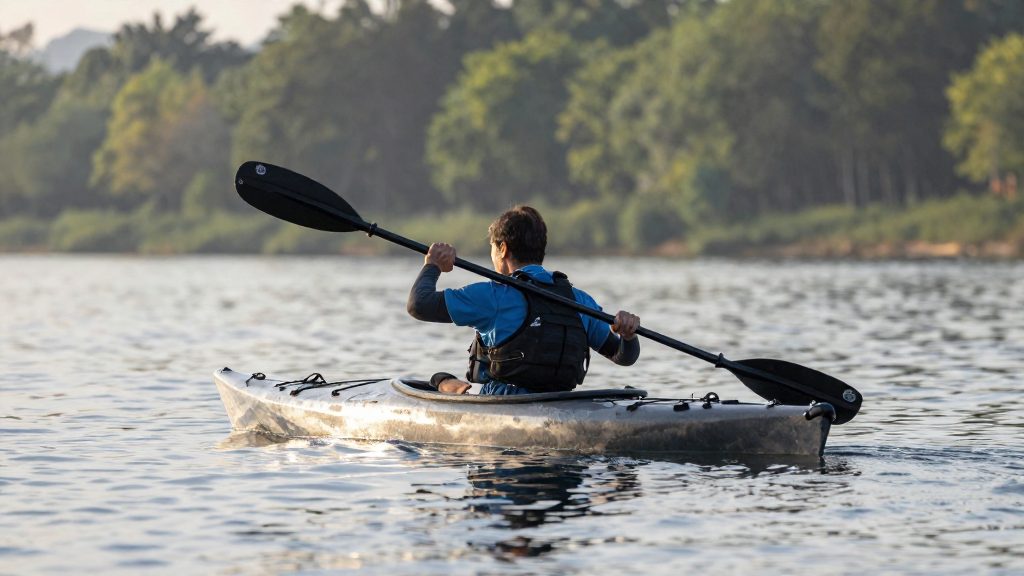
An adjustable paddle with a carbon shaft is a practical choice for recreational kayaking when you need to fine-tune the fit or accommodate different boats. Choose a paddle whose length range covers your seated reach, with blades suited to relaxed paddling and a joint that locks securely. Carbon construction can help keep weight down, but the complete paddle’s fit, balance and handling determine whether it is a useful upgrade.
Why look beyond the carbon label?
A kayak paddle has distinct components: the shaft you hold, the blades that move through the water, and the joint connecting the sections. The joint is often called a ferrule. Check the construction of each component rather than treating “carbon” as a description of the entire paddle.
| Construction term | What it means for your purchase |
|---|---|
| Carbon shaft | Describes the shaft material; check the blades separately |
| Carbon-blend shaft | Contains a mixture of reinforcing materials rather than an all-carbon construction |
| Fibreglass-reinforced nylon blade | A moulded nylon blade reinforced with glass fibres |
| Carbon-reinforced nylon blade | A moulded nylon blade reinforced with carbon fibres |
| Carbon blade with a foam core | A different construction from carbon-reinforced moulded nylon |
These distinctions appear in the manufacturer’s recreational paddle specifications, material descriptions and Canadian carbon-paddle listing.
Compare complete-paddle weight rather than assuming that a carbon shaft guarantees the lightest assembled paddle. Blade construction and the adjustment mechanism also contribute. When trying a paddle, alternate relaxed strokes: weight at the blade ends can feel different from weight concentrated near your hands. A comfortable demonstration is more useful than a promise of effortless paddling.
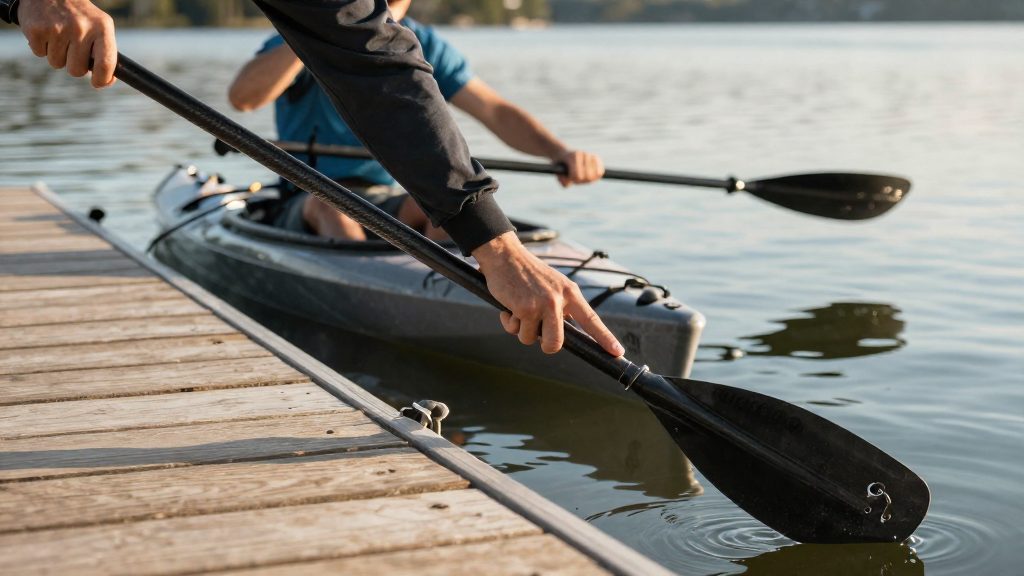
How should you read the published specifications?
Use the specifications for the exact version you intend to order. A fixed-length version, an adjustable version and a travel version can share similar names while having different dimensions or weights.
For a concrete example, the manufacturer’s Canadian specifications for a carbon-shaft paddle with foam-core carbon blades state:
| Specification | Published value for that paddle |
|---|---|
| Overall adjustable length | 220–230 cm |
| Feather adjustment | 0–90° |
| Complete paddle weight | 0.82 kg |
These figures describe that particular product, rather than a recommended size for every recreational kayaker. In particular, the length interval tells you where adjustment starts and ends; it does not establish whether either endpoint suits your boat.
Before ordering, ask the seller to confirm the selected length range, shaft diameter and included components. If a product page offers variants that do not match its written description, obtain confirmation of the actual item. For a Canadian purchase, also establish who handles service and whether replacement components can be supplied locally. Keep the specification page and purchase receipt together so the precise version remains identifiable later.
How do you choose a length range for your kayak?
Start with your height and the kayak’s width at its widest point, then consult the paddle manufacturer’s sizing guidance. Seat height and paddling style also affect the fit. A raised seat increases the distance between your hands and the water; a broad recreational kayak requires clearance around its sides. These are recognised fitting factors in the manufacturer’s kayak paddle sizing guide.
Set up the boat as you actually paddle it. Adjust the seat and foot supports, and wear your usual paddling clothing and flotation device. An inflatable kayak should be prepared according to its own instructions before assessing reach.
During a sheltered-water trial, look for these signs:
- Your hands clear the kayak without an exaggerated sideways movement.
- The working blade enters the water properly without requiring you to lean out.
- Your shoulders remain comfortable rather than lifting repeatedly to compensate for poor reach.
- The stroke feels controlled rather than like an unnecessarily wide sweep.
Choose an adjustment interval that accommodates the settings you expect to use. If sharing the paddle, each person needs a fitting trial. Record successful settings against the relevant boat and seat position; a useful setting in one kayak is not automatically transferable to another.
Which blade shape suits relaxed recreational paddling?
Low-angle paddling uses a relatively horizontal shaft and a lower upper hand. Longer, narrower blades are designed for that entry angle and are a sensible starting point for unhurried lake outings and sheltered touring. Shorter, wider blades generally match a more upright stroke. The relationship between blade shape and stroke angle is explained in the manufacturer’s touring design guidance.
Blade shape also affects how smoothly the paddle moves through the water. An asymmetrical blade helps balance loading during entry and exit. A dihedral blade has a raised shape along its working face that directs water towards either side, helping limit flutter. These features concern control and feel, rather than simply how forcefully you can pull.
During a demonstration, avoid judging the paddle only by a hard acceleration. Try ordinary cruising, gentle steering and stopping. Notice whether the blade tracks smoothly through the stroke and whether you can maintain a relaxed grip. If it repeatedly twists in your hands, ask an instructor or retailer to check its orientation and your technique before choosing a larger blade.
How do length adjustment and feathering differ?
Length adjustment changes the paddle’s overall reach. Feathering changes the relative rotation of the blades: they can lie in the same plane or be offset. A paddle that separates for storage does not necessarily provide adjustable length, and an adjustable joint may offer either selected feather positions or continuous rotation. The manufacturer’s ferrule documentation describes these as separate capabilities.
For an initial trial, an unfeathered setting makes blade orientation straightforward. Experiment with an offset later in calm, sheltered conditions, preferably with instruction. Keep your wrists comfortably aligned rather than forcing them to accommodate an unfamiliar setting. Wind can affect the exposed blade, but increasing feather is not a substitute for choosing suitable paddling conditions.
Before launching, follow this joint check:
- Read the locking instructions for the particular mechanism.
- Assemble the sections with the required insertion depth and within all marked limits.
- Close the lock completely, then gently check for unwanted sliding or rotation.
- Confirm that you can operate the release with the equipment you will wear.
If the joint slips, return to shore and resolve the problem before continuing. Make setting changes somewhere stable, where opening the connection cannot leave you struggling to control the boat.
What matters when transporting a sectional paddle?
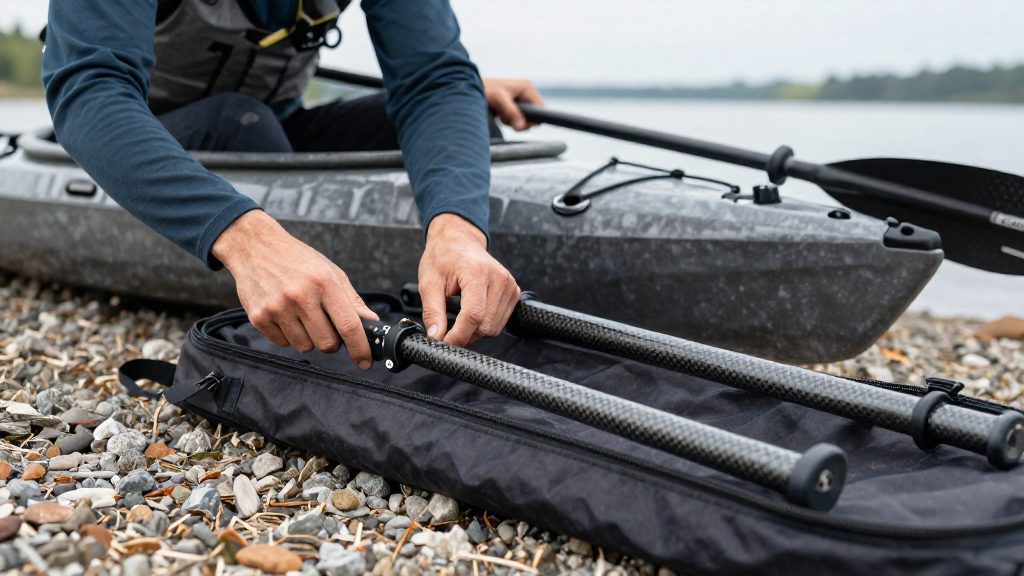
Choose the breakdown arrangement around your actual storage space. A paddle separating at its centre may suit a car or garage, while removable blades can make packing easier alongside a folding or inflatable kayak. The Canadian paddle listing, for example, documents a four-piece design supplied with a padded carrying case.
Ask for the longest packed component’s measurement rather than estimating it from the assembled length. Blade shape, joint overlap and the position of the connections affect the packed dimensions. Check the bag opening as well as its internal space.
Keep hard fittings and loose equipment from pressing against the shaft during transport. Support the components and protect blade edges from repeated knocks. When packing a wet paddle for the journey home, plan to unpack it for drying. A protective case is useful for carrying, but should not become permanent damp storage.
When should you clean, inspect or stop using the paddle?
After each outing, separate the sections, rinse them with fresh water and remove sand, plant fragments and other debris from the connection. Check inside the shaft openings and allow the components to drain and dry apart. Store them in a clean, dry indoor space where practical. This routine follows the manufacturer’s paddle-care guidance, published in 2019.
Before the next outing, inspect the shaft, blade roots and locking components. Look for cracks, lifted fibres, sharp splinters, distortion or a new change in the way the connection fits. Surface scuffs and structural damage need different responses: if you cannot confidently distinguish them, send clear photographs to the manufacturer and request an assessment.
Stop using a paddle with suspected structural damage or a connection that will not retain its setting. Do not treat tape around a damaged shaft as clearance to resume a trip. Resume normal use after an approved repair or replacement, followed by the manufacturer’s assembly and function checks.
Use cleaning products and any joint treatment only as permitted for that paddle. Instructions for a different blade material or locking system may be unsuitable.
What Canadian safety preparation belongs with the paddle?
Transport Canada states that human-powered craft must carry the safety equipment specified by the Small Vessel Regulations and the Safe Boating Guide. Check the applicable requirements for your kayak type and outing rather than assuming that owning a paddle completes the equipment list. See Transport Canada’s human-powered craft guidance, modified in 2019.
Wear a properly fitted, Canadian-approved lifejacket or personal flotation device while paddling. Transport Canada explains that unexpected cold-water immersion can impair breathing and muscle function, making it difficult to put flotation on after a capsize. Check the approval label and practise using your device before relying on it. See Transport Canada’s flotation-device guidance, modified in 2025.
Plan the route around wind, water temperature, currents and a realistic return journey. Coastal trips also require attention to tides and vessel traffic. Choose visible clothing and equipment, and keep signalling devices within reach, as Transport Canada advises. If conditions exceed your ability to control the kayak and return safely, postpone the outing. A different paddle setting cannot make an unsuitable route safe.
Frequently asked questions
Will a carbon-shaft kayak paddle float?
Check the exact paddle’s buoyancy information. Some designs use internal foam plugs to trap air and support flotation; the shaft material alone does not establish whether the assembled paddle or its separate sections will float. See the manufacturer’s buoyancy explanation.
Can I replace a lost blade with a similar-looking component?
Ask the manufacturer to confirm compatibility. Matching appearance does not establish a correct fit. Some manufacturers require the remaining components to match a replacement accurately; see the replacement-parts guidance.
Can I shorten an existing carbon shaft by cutting it?
Contact the manufacturer before making permanent alterations. Cutting can affect the joint, grip arrangement and structural integrity. Availability of alterations varies, and some manufacturers decline them, as explained in this modification policy.