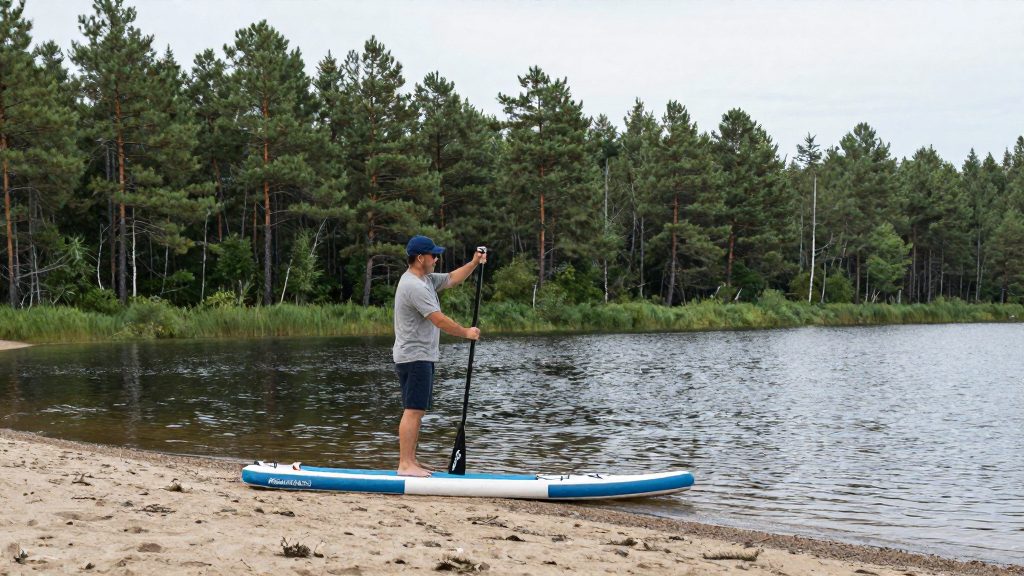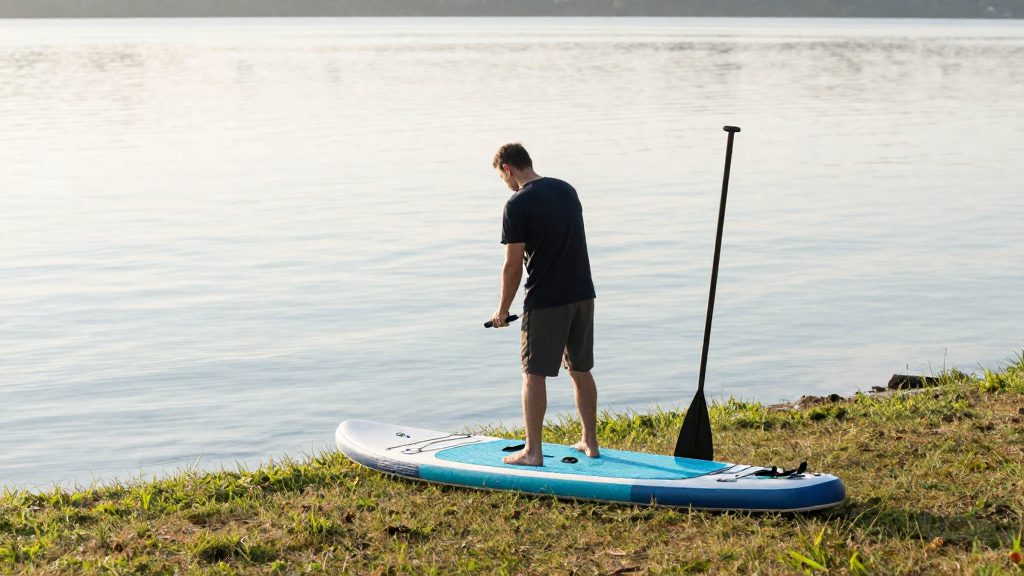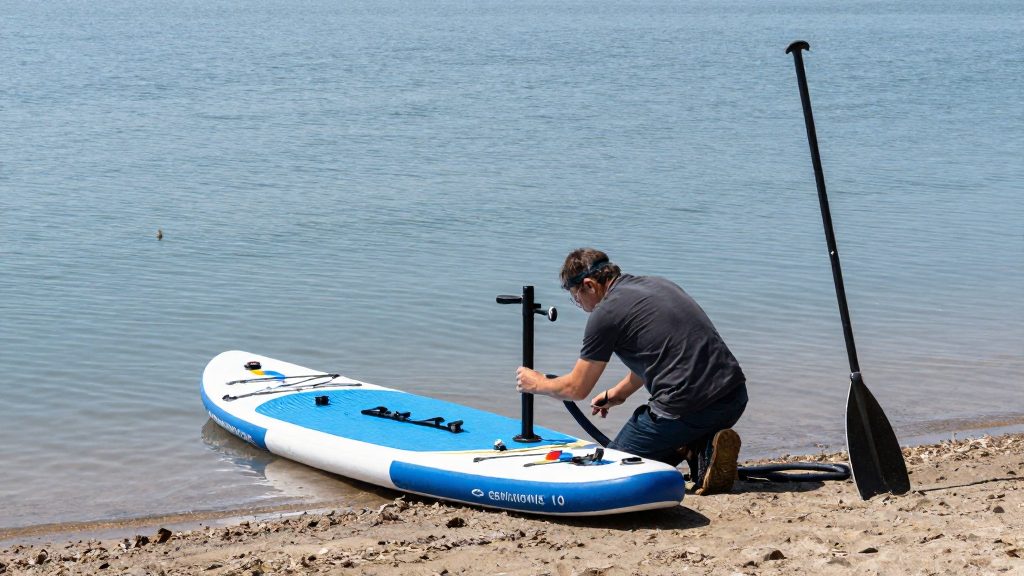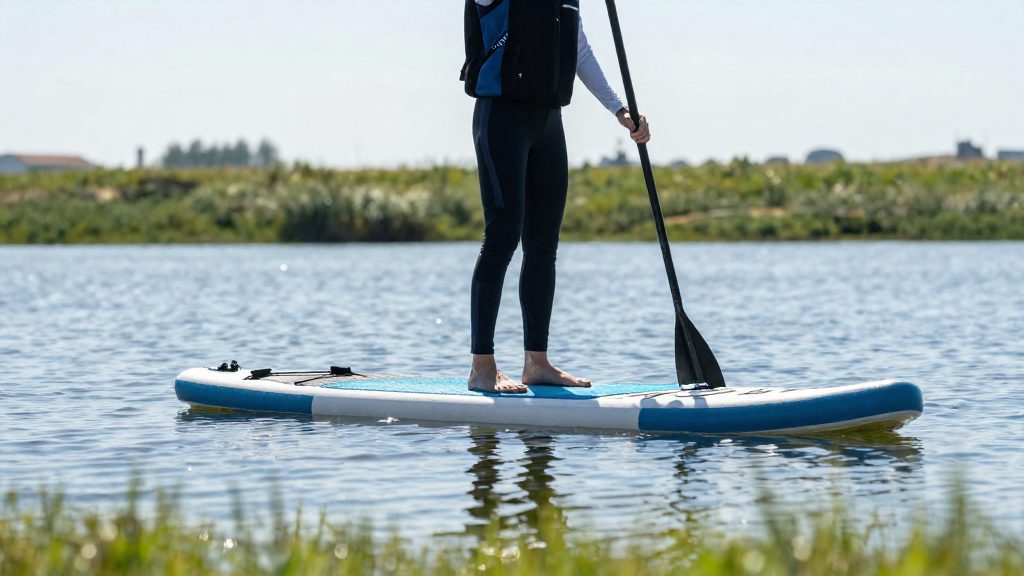
To stand up on a paddle board for the first time, move from kneeling into a supported squat, then straighten your legs gradually while bringing the paddle with you. The aim is a controlled transition that leaves you ready to paddle. Before attempting it, set up a practice session where a loss of balance is manageable and help is available.
Where should you practice your first stand?
Choose a small lake or a protected bay with flat water, little boat traffic, and an accessible shoreline. The Minnesota Department of Natural Resources recommends these settings for beginners. Leave exposed crossings, tidal channels, and flowing rivers for later instruction.
Evaluate the whole practice area, including where you might drift:
| Check | Suitable conditions for a first attempt |
|---|---|
| Water surface | Calm enough to concentrate on your movements without repeated waves or boat wakes |
| Bottom | Free of submerged rocks, branches, and other objects you could strike |
| Shore access | A permitted launch with secure footing and a straightforward landing |
| Other users | Enough separation from swimmers, docks, and moving boats |
| Assistance | An instructor or capable paddling partner nearby |
Read the forecast for the full outing, including wind direction, gusts, and approaching storms. Avoid wind blowing away from your launch toward open water. Ask the local outfitter or site manager whether conditions suit a complete beginner. The Maryland Department of Natural Resources advises monitoring weather throughout a paddle and leaving the water when thunder or lightning appears.
Prepare for immersion, not just the air temperature
Check the water temperature before choosing clothing. The National Weather Service explains that sudden cold-water immersion can cause involuntary gasping and rapid breathing, even in confident swimmers. A warm afternoon does not make cold water safe for practice falls.
Wear thermal protection appropriate for immersion, such as a suitable wetsuit or dry suit, when conditions require it. Have an instructor help you choose and use unfamiliar equipment. If you lack protection for the water temperature, postpone the session or choose a warmer location. Keep dry replacement clothing available ashore.
What board and safety equipment should you use?
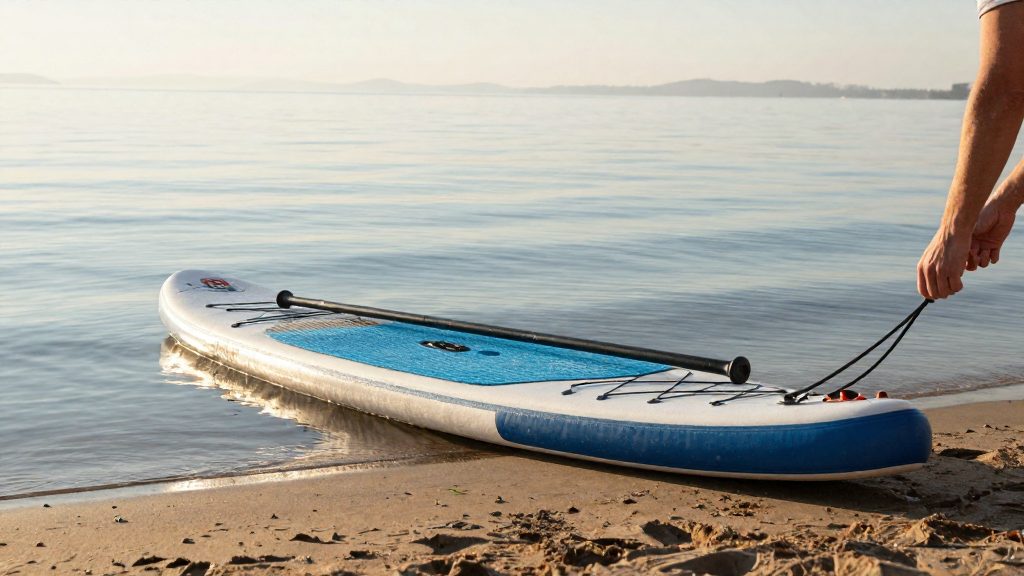
A broad all-around board is a practical learning platform. Its fuller outline provides more stability than a narrow performance shape. Both inflatable and hard boards can work; the manufacturer’s beginner guide describes both as options for learning.
Check the actual board’s documentation rather than choosing by appearance alone:
| Component | What to verify |
|---|---|
| Board capacity | The recommended rider range suits your body weight and anything carried aboard |
| Inflatable board | Inflation matches the pressure instructions for that model; the valve is secured |
| Fin | It is correctly installed and its retaining mechanism is secure |
| Standing area | The traction pad is clear of loose equipment and anything slippery |
| Adjustable paddle | The length suits you according to its instructions, and the adjustment mechanism holds securely |
Use the board’s own operating instructions for assembly and inspection. A manufacturer’s owner’s manual, for example, identifies valve security and paddle adjustment as prelaunch checks. Do not transfer a pressure setting from a different board.
Wear a properly fitted life jacket
For a beginner expecting possible immersion, a suitable foam paddling life jacket is a straightforward choice. Fasten and adjust it before launching. According to the U.S. Coast Guard, a correctly fitted foam jacket should feel snug and should not rise above your chin or ears. Check its label for the intended user and activity.
The legal boundary matters: the U.S. Coast Guard Auxiliary explains that paddleboards operated beyond the narrow limits of swimming, surfing, or bathing areas are treated as vessels and must meet applicable equipment requirements. These include an appropriate Coast Guard-approved wearable life jacket for each person. The Coast Guard recommends wearing it whenever underway. Check state and site-specific requirements as well, including children’s wear rules.
Match the leash to the environment
On sheltered flat water without entanglement hazards, an appropriate board leash helps prevent separation after a fall. It supplements your life jacket.
An ankle leash can snag in flowing water and hold a paddler against the current. The Pennsylvania Fish and Boat Commission recommends a quick-release waist leash where entrapment is a concern. River paddling requires instruction in the equipment and its release. For this first standing session, choose still water and have the instructor confirm your leash setup.
Attach a whistle to your life jacket. Tell someone ashore your location and expected return, and carry a phone in a suitable waterproof case, as recommended by the Minnesota Department of Natural Resources.
How do you launch and get comfortable on your knees?
Wade out until the loaded board’s fin clears the bottom. This clearance protects the fin; it does not establish that the water is deep enough for a safe fall. Have your instructor identify a suitable standing area with adequate depth and no underwater obstacles.
Place the paddle across the deck just ahead of the center carry handle. With your hands supporting you, bring your knees onto the board on opposite sides of the handle. Face the nose, which is the front of the board.
Paddle away from the immediate launch area while kneeling. Get used to how the board responds to strokes on either side. The manufacturer’s getting-started demonstration, updated in 2013, recommends kneeling practice before standing. Learn to change direction and slow down in this lower position before adding the balance challenge of standing.
How do you stand up step by step?
Once you reach the clear practice area, use this sequence:
- Support your upper body. Lay the paddle across the deck in front of your knees. Place your hands on the deck over the shaft so it stays within your control.
- Bring a foot underneath you. Keep weight through your hands while moving that foot into the space where its knee was resting. Set the sole flat rather than balancing on your toes.
- Place the other foot. Bring it underneath you in the same way, arriving in a compact squat. Keep your weight centered rather than pushing hard through an outside edge.
- Lift smoothly. Take the paddle with you as you extend your legs and bring your chest upright. Avoid a sudden jump or an abrupt backward lean.
- Start paddling. Bring the blade into the water and begin a controlled stroke instead of holding the paddle overhead while trying to balance.
This progression follows the manufacturer’s standing instructions. There is no need to force the movement if a foot catches or your weight shifts awkwardly. Return to your supported position and reset.
Establish your standing position
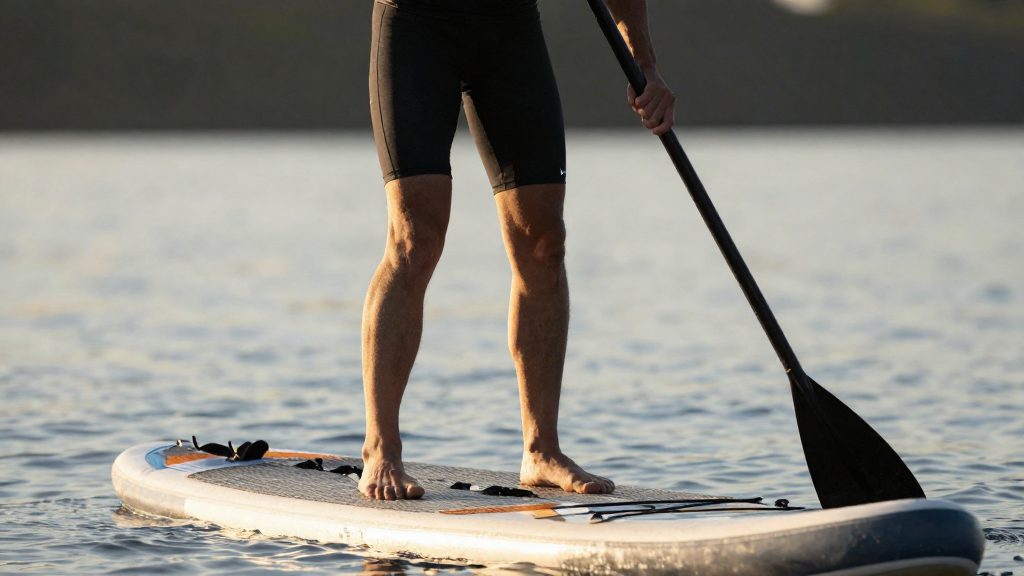
Use a parallel stance for flatwater learning: feet about shoulder-width apart, toes pointing toward the nose, and a foot on either side of the board’s centerline. Start around the center carry handle, keeping your soles on the traction pad.
Distribute your weight evenly. Your knees should remain slightly bent so your legs can accommodate small movements beneath you. Keep your torso upright and look toward a fixed point ahead. The Professional Stand Up Paddle Association’s 2019 instructional guide teaches these stance and posture principles.
The board should also sit level from front to back. If the nose or tail is excessively lifted, adjust your position cautiously with small movements rather than a large step.
How should you use the paddle once you are upright?
Hold the top grip with the hand opposite your paddling side, with your other hand lower on the shaft. For a stroke on the right, your left hand holds the top grip. Swap hand positions when changing sides.
On a conventional angled SUP paddle, the blade’s angle points toward the nose. Check the paddle’s instructions if its shape makes orientation unclear. The manufacturer’s first-time paddling guide, published in 2020, illustrates the grip and forward-facing blade angle.
For a comfortable forward stroke:
- Reach forward within your balance range and immerse the blade.
- Use a controlled rotation of your torso to move the board past the planted blade.
- Finish the pull around your feet, then lift the blade clear for recovery.
- Keep your arms relatively relaxed instead of trying to generate all the effort by bending your elbows.
These movements follow the manufacturer’s forward-stroke demonstration, updated in 2013. Keep the shaft relatively vertical when viewed from the front, and change sides as needed to maintain your heading, as explained in its straight-line paddling guidance.
Practice braking before approaching anything solid. Check behind you, then use gentle backward strokes to slow forward movement. For a basic turn, sweep the blade outward in a broad arc from the nose toward the tail; a sweep on the left turns the nose right. The Professional Stand Up Paddle Association teaches these beginner control movements. Leave step-back turns until you have more experience.
What should you do if you fall?
If your balance is gone, aim to land in the water beside the board, away from its deck and edges. Spread yourself across the surface rather than diving headfirst or jumping feetfirst toward an unseen bottom. Do not reach back to catch yourself on the board.
Keep the paddle if you can do so without compromising your landing. As you surface, protect your head with an arm and locate the board before moving underneath or beside it. These fall precautions are described in the Professional Stand Up Paddle Association’s guide.
Climb back aboard before another attempt
Approach the board from the side near its middle:
- Put the paddle across the deck.
- Hold the center carry handle or a secure deck grip, and reach toward the opposite rail if you can comfortably reach it.
- Kick your legs near the surface while pulling your chest across the deck.
- Slide your hips aboard and stay low until your weight is centered.
The manufacturer’s recovery instructions describe the combined kick and pull. Think of sliding across the board rather than trying to lift your whole body vertically from the water.
Practice recovery with supervision while wearing your actual life jacket. If the jacket catches, the rail is difficult to reach, or repeated efforts exhaust you, have the instructor help and teach an alternative remount. Keep the jacket on. Successful standing does not establish that you can recover independently after falling.
If you lose the paddle, regain the board first. You can then paddle with your hands to retrieve it when safe. If you cannot get back aboard, hold the board for support and signal for assistance.
When should you stop practicing and return?
End the standing attempts when fatigue makes your movements less controlled, you become cold, or conditions begin to exceed your ability. Return to kneeling while you still have control, rather than waiting for a fall. A lower position can help you manage the board, but it does not make worsening weather safe.
Approach the landing slowly. Get low before entering shallow water, stop before the fin grounds, and step off only after checking depth and footing. Do not jump toward a dock or rocky bank. The manufacturer’s operating instructions specifically warn against standing near objects that present a falling hazard.
Frequently asked questions
Can I learn to paddleboard if I am not a confident swimmer?
Build swimming competence before paddling independently, and discuss your ability with a qualified instructor before booking a lesson. Minnesota’s Department of Natural Resources recommends knowing or learning how to swim. A life jacket does not replace that skill, and some buoyancy aids are unsuitable for weak swimmers.
Does a paddle board need registration or a launch permit?
Requirements depend on the state, waterway, and launch owner. Check your state boating agency and the site’s rules before visiting; do not assume an unpowered board is exempt. Minnesota’s Department of Natural Resources, for example, lists paddleboard registration requirements.
How can I keep my prescription glasses secure while learning?
Use an eyewear retainer designed to fit your frames, and check its attachment before launching. The Maryland Department of Natural Resources recommends a glasses or sunglasses strap to reduce the chance of losing eyewear in the water.