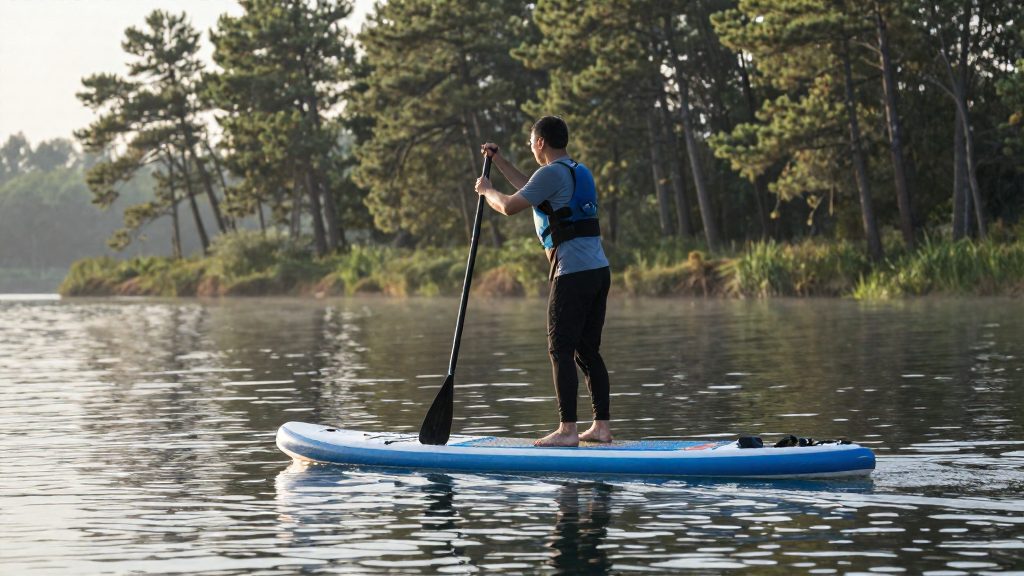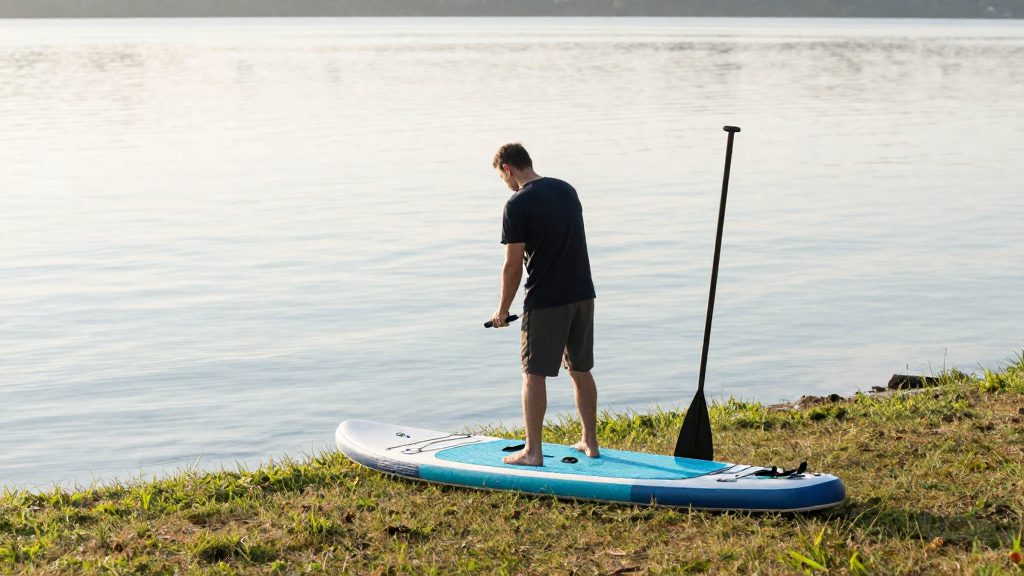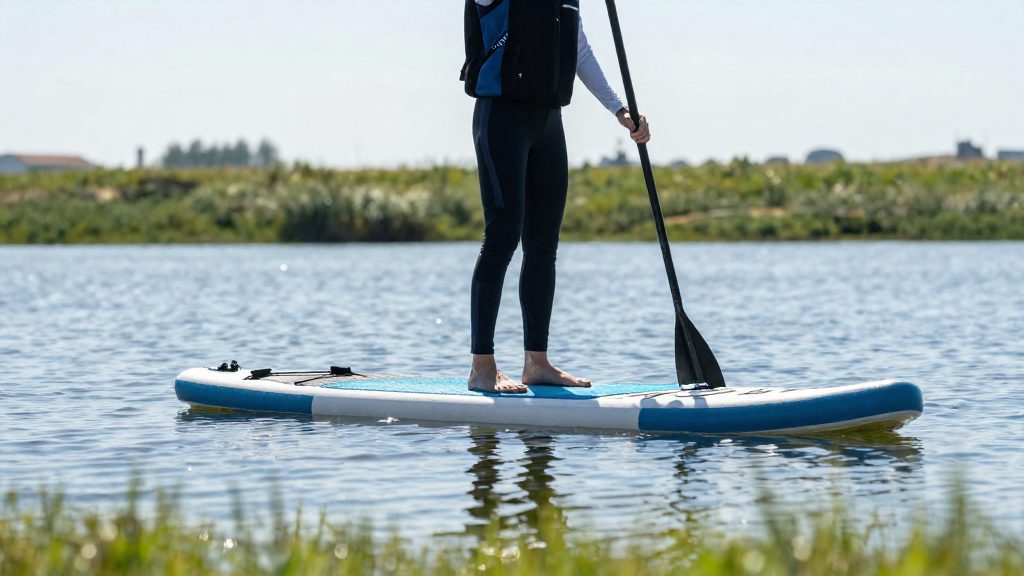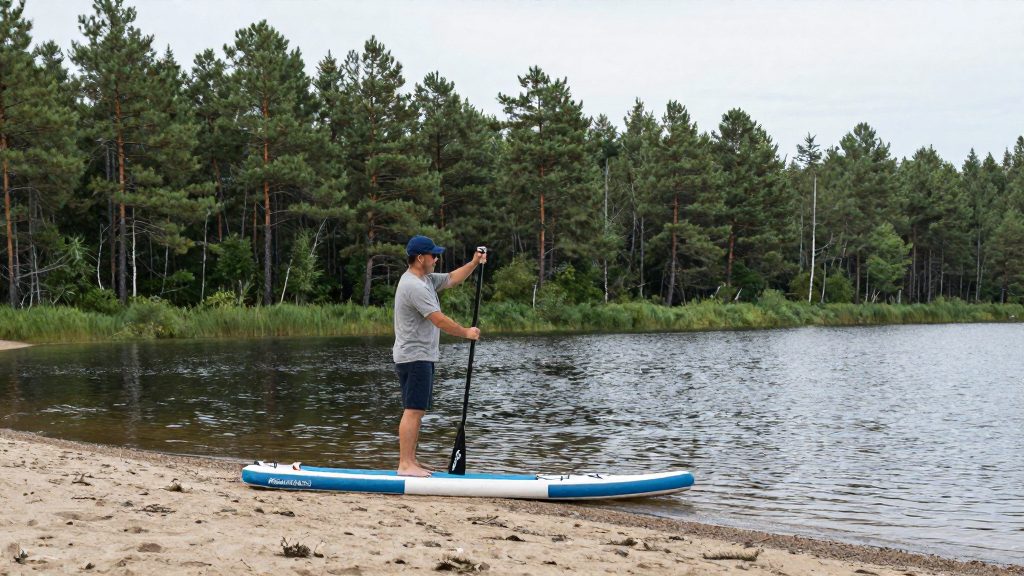
For recreational paddling, start by considering boards around 10 feet 6 inches to 12 feet long, a range identified in a manufacturer’s sizing guide. Choose within that range using your weight, intended activity, and the board’s recommended loading. Use your height to assess balance and comfortable paddling reach; do not select length from height alone.
How do you calculate the weight your board must carry?
Work out your actual paddling load before browsing board lengths. Use this checklist to avoid comparing your body weight with a capacity that must also accommodate equipment.
| Load component | What to include |
|---|---|
| Paddler | Your weight wearing the clothing and safety equipment you will use |
| Passengers | Anyone who will ride with you |
| Pets | The animal and its equipment |
| Supplies | Drinking water, food, and packed belongings |
| Activity equipment | Fishing equipment, camping supplies, or other items carried aboard |
Total onboard load = dressed paddler weight + passenger and pet weight + equipment and supplies.
Weigh packed bags rather than estimating their contents. If your outings vary, calculate the load for the most demanding trip you actually intend to make.
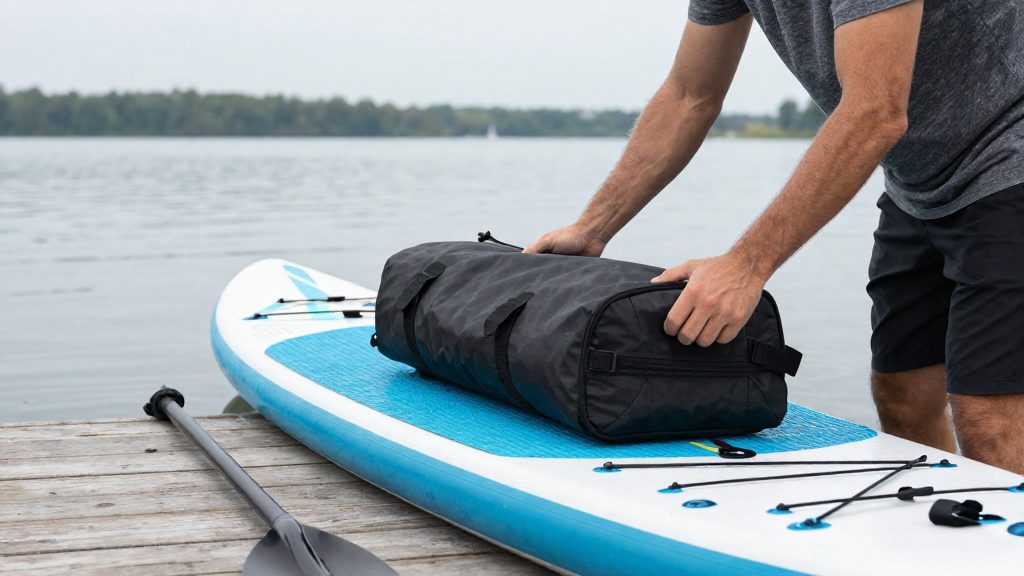
A manufacturer’s capacity guide specifically includes passengers, pets, equipment, food, and water when assessing loading. It also explains that exceeding suggested capacity makes a board ride lower and increases drag. A board that remains afloat can still be an inefficient, unsuitable platform for paddling.
Why do weight-capacity labels need interpretation?
Capacity terminology can describe different things. A recommended paddler weight may refer to the person standing on the board, while a total-load limit may include everyone and everything aboard. A maximum figure also may not describe the loading that produces the best paddling performance. A manufacturer’s explanation of rider-weight ratings distinguishes its paddler recommendation from total carrying capacity.
Read the exact wording for the model you are considering:
- Recommended rider range: Check whether the recommendation accounts for experience and intended use.
- Maximum rider weight: Ask whether additional cargo is allowed separately.
- Maximum total load: Compare it with your complete onboard load.
- Unexplained capacity: Ask the manufacturer what the figure measures before relying on it.
Leave room below the applicable maximum rather than planning to operate at the limit, as advised in a manufacturer’s sizing article dated January 2, 2019. Ask for a suitable performance recommendation for your circumstances instead of applying an arbitrary reserve to every board.
How does your height affect the choice?
Height changes how you balance and handle a board, but it does not tell you how much support the board needs. A tall, light paddler and a shorter, heavier paddler can require different designs even when their preferred activity is identical.
| Your build | What to investigate during selection |
|---|---|
| Tall and relatively light | A stable standing platform without unnecessary bulk |
| Tall and heavier | A suitable rider recommendation alongside manageable handling |
| Shorter and lighter | Comfortable reach over the sides and easy control |
| Shorter and heavier | Adequate support without automatically choosing the widest available shape |
The manufacturer’s height-and-weight guidance identifies balance and control as relevant considerations and gives weight greater importance for buoyancy.
Pay attention to your reach. During a fitting or lesson, check whether you can put the paddle blade into the water beside the board without repeatedly leaning sideways. The University of Maine’s outdoor leadership curriculum identifies width as a factor in both stability and ease of paddling.
Match length and shape to your usual activity
Choose for the outing you will do regularly. Occasional ambitions should not dictate equipment that feels awkward on your normal route.
| Main activity | Length and layout priorities |
|---|---|
| Relaxed lake or sheltered-bay paddling | An all-around design that feels manageable during launches, stops, and changes of direction |
| Recreational touring | A touring design that holds its course efficiently over sustained paddling |
| SUP yoga | Usable deck space and a layout that does not place fittings where you move |
| Fishing | Room for your actual equipment while preserving an unobstructed standing area |
| Short exploratory outings | Handling that suits frequent turns and close shoreline navigation |
Longer boards generally favor straight-line travel, while shorter boards generally turn more readily. The manufacturer’s explanation of board dimensions describes this tradeoff.
For touring, look at the manufacturer’s intended-use designation rather than treating a length category as a guarantee. Hull shape—the shape of the underside—and the fin arrangement also affect how the board moves. The University of Maine curriculum explains the fin’s role in turning and maintaining direction.
Read width, thickness, and volume alongside length
Length is only part of the specification. Record the other dimensions before deciding whether a board suits your body and activity.
| Specification | What it tells you | How to use it |
|---|---|---|
| Width | The board’s side-to-side dimension | Assess the balance between stability and comfortable paddle reach |
| Thickness | The distance between deck and underside | Consider it alongside construction and stiffness |
| Volume | The board’s volume, usually stated in liters | Read it with the manufacturer’s rider recommendation |
| Board weight | The weight you must lift and carry | Check whether you can manage the board at your launch |
A manufacturer’s beginner guide published in 2019 recommends widths of 32 to 34 inches for beginners. Treat that as a starting point for assessment, not a requirement for every body type or activity.
Thickness needs particular care when comparing inflatables. Construction can allow a thinner board to remain stiff, so thickness alone cannot establish quality or suitability. The manufacturer’s construction discussion describes that relationship.
Use published specifications rather than calculating capacity from length, width, and thickness. Shaped noses, tails, and rails mean those external measurements do not describe a simple rectangular container. More importantly, a homemade volume estimate cannot establish a recommended paddling load.
What changes between inflatable and hard boards?
For an inflatable, pressure is part of the setup that allows the board to perform as intended. Before evaluating one, use a compatible pump and pressure gauge to reach the operating pressure specified for that exact board. Follow its instructions for any separate chambers. Do not borrow a pressure recommendation from a different model.
A manufacturer’s inflatable-board owner’s manual explains how internal drop-stitch threads connect the upper and lower surfaces and recommends a reliable pressure gauge. It also warns against using a high-pressure air compressor because of overinflation risk.
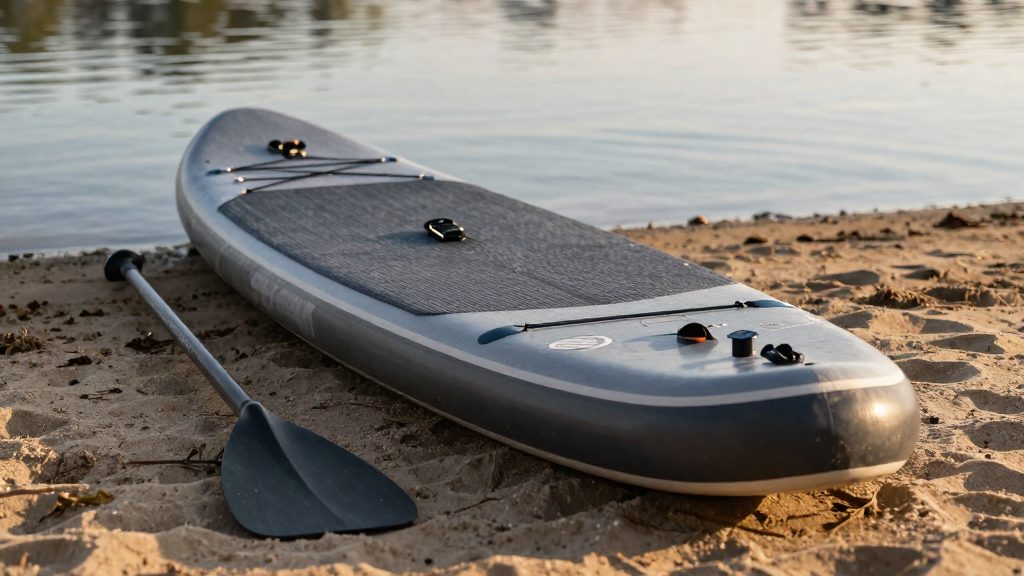
Transport creates a separate fit question. An inflatable can be deflated for packing; a conventional hard board retains its full dimensions. A manufacturer’s technical product description illustrates the transport advantage of a board that rolls up after deflation.
Before choosing a hard board, measure the storage location and access route, including doorways and turns. For an inflatable, check the packed bag’s dimensions and complete carrying weight, including its pump. Either way, try lifting and carrying the equipment you expect to handle yourself.
Test the shortlist on the water
Arrange a rental, lesson, or demonstration when possible. Treat the session as a practical assessment of tasks you need to perform, rather than a test of whether you can stand briefly.
Ask an instructor to help you assess:
- Starting and stopping: Can you get underway and stop deliberately without losing control?
- Turning: Can you change direction confidently within the space available at your usual paddling location?
- Sustained paddling: Does the board remain comfortable once the initial concentration of standing up has passed?
- Deck access: Can you reach the belongings you need without stepping into an awkward position?
- Reboarding: Can you get back aboard after entering the water, using a technique suitable for that board?
Practice reboarding with supervision in a controlled location free of underwater obstacles and boat traffic. Difficulty getting back aboard is a reason to address technique, equipment suitability, or both before taking a longer outing.
Keep brief notes after each demonstration. Record the specific task that felt difficult so a retailer or instructor can suggest a meaningful adjustment. The Pennsylvania Fish and Boat Commission recommends paddlesports instruction covering equipment, water skills, and hazard identification.
Set safe conditions for the first outing
A suitable board still requires suitable conditions. Begin on sheltered, calm water with an easy landing, stay within your abilities, and paddle with someone else. Watch for changing weather and return before control deteriorates. These practices follow the Pennsylvania Fish and Boat Commission’s paddling guidance.
Wear a properly fitted, U.S. Coast Guard-approved life jacket and carry a whistle. The U.S. Coast Guard explains that a SUP used beyond the narrow limits of a swimming, surfing, or bathing area is treated as a vessel for applicable requirements. Check your state boating authority and launch rules for additional obligations.
Select a leash for the waterway. The Oregon State Marine Board’s June 9, 2025 safety guidance warns against ordinary ankle or leg leashes in moving water because of entanglement risk and describes body-mounted quick-release alternatives. Get instruction before using that equipment in current.
Finally, dress for water temperature. The National Weather Service warns that warm air can conceal dangerous cold-water conditions and recommends appropriate immersion protection. Postpone the outing if you cannot prepare for falling in safely.
Frequently asked questions
Does my paddle need to get longer when I buy a longer board?
Paddle length should suit your height and paddling activity. A longer board does not automatically require a longer paddle. An adjustable paddle lets you refine the fit, as explained in this manufacturer’s paddle-sizing guidance.
How can I find sizing information for a used board?
Ask the seller for the exact model, size, model year, and identifying label photographs. Request the matching specifications and instructions from the manufacturer before buying. Use documentation for that version rather than assuming the current board with a similar name has identical specifications.