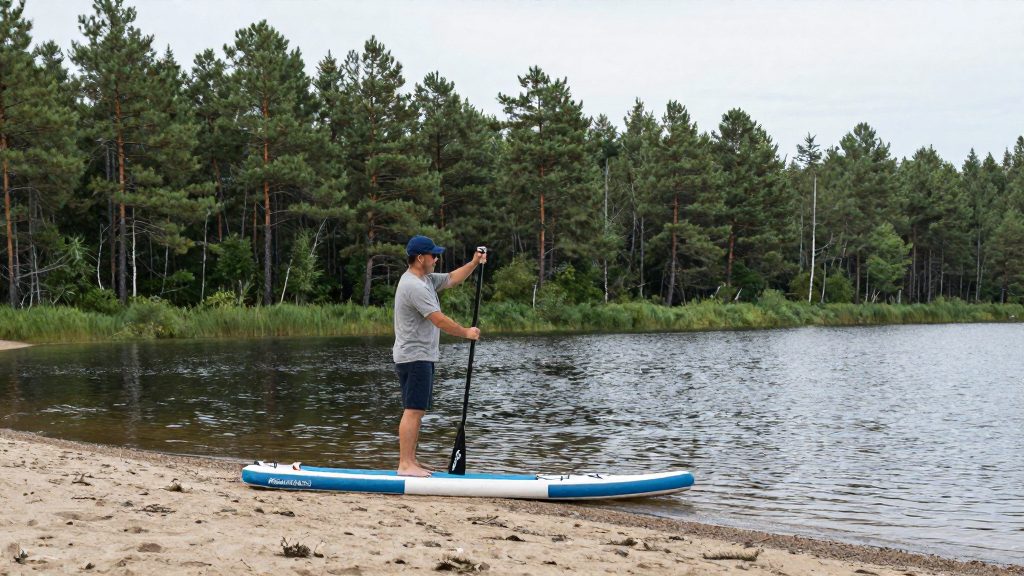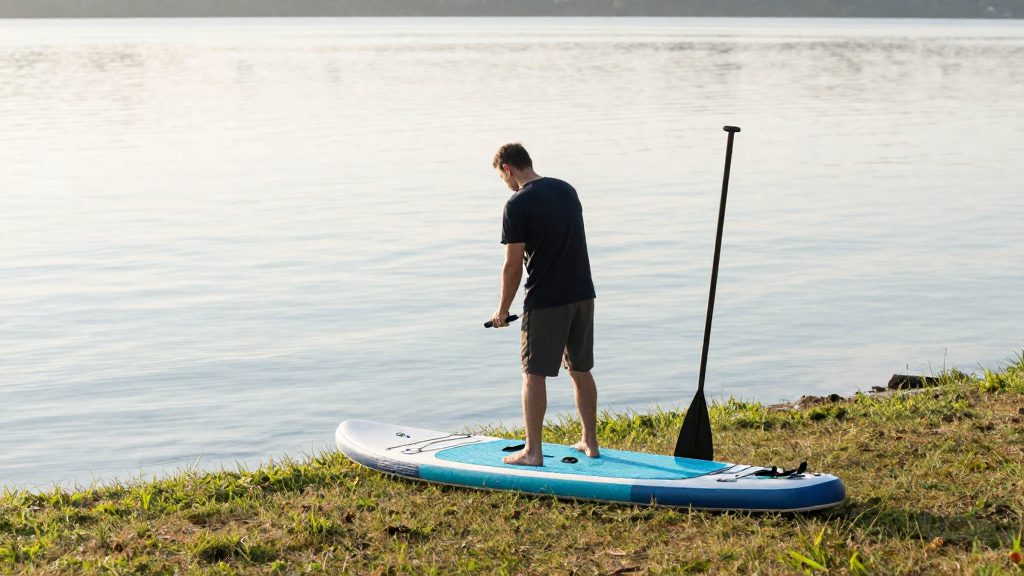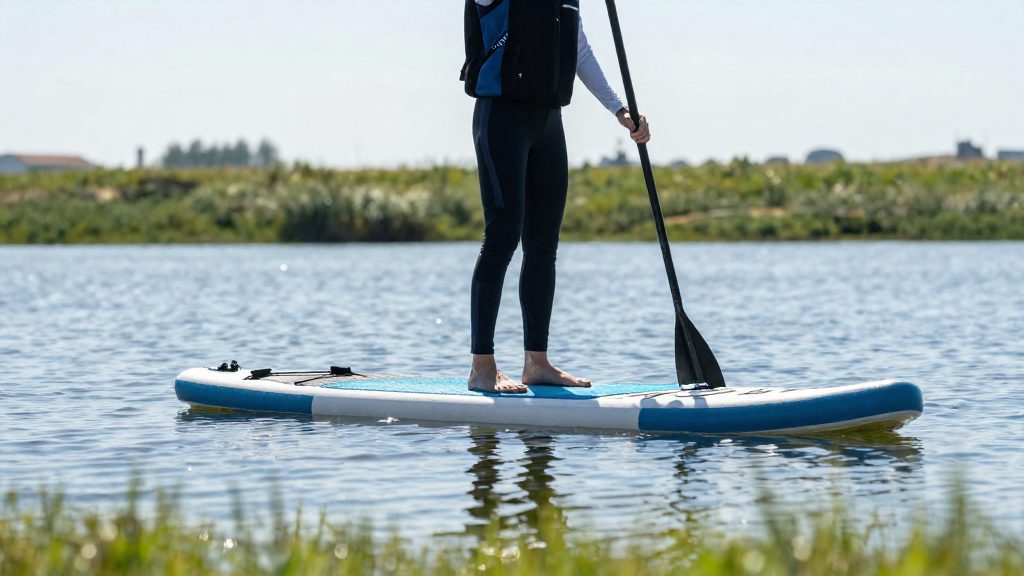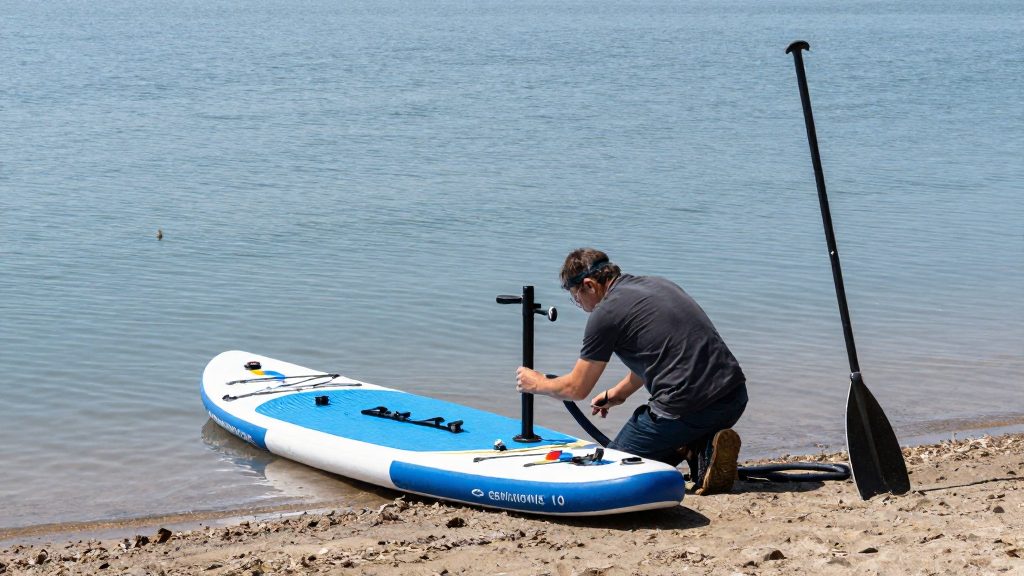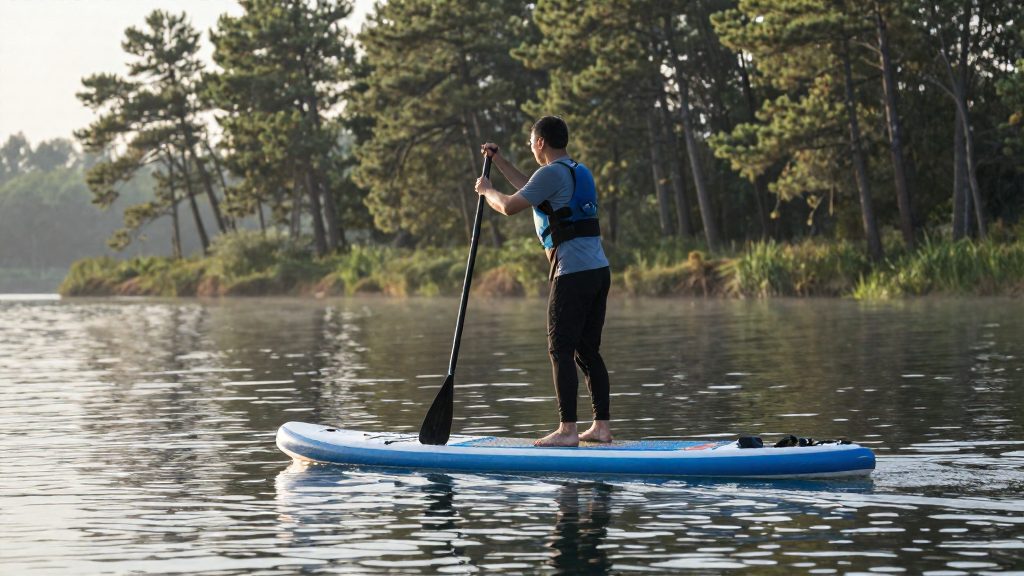
For a 200-pound adult learning to paddle solo on calm water, the best starting size is a 10 ft 6 in long, 34 in wide all-around board, with enough rated capacity for the complete onboard load. The 285 lb-rated example below is my recommendation for this use. This recommendation follows the dimensions and intended use in the manufacturer’s SUP size chart; it assumes recreational paddling with light cargo.
Which verified board sizes fit this rider?
These concrete examples show how suitable dimensions change with the activity. Capacities belong to the specific models and sizes listed.
| Model and size | Construction | Dimensions | Listed capacity | Recommended role |
|---|---|---|---|---|
| Pioneer 3 | Inflatable | 10 ft 6 in × 34 in | 285 lb | First choice for a beginner’s calm-water recreation |
| Explorer 3 | Inflatable | 11 ft 6 in × 32 in | 300 lb | Alternative for longer paddles after developing balance |
| Versa, larger version | Rigid epoxy | 11 ft 2 in × 33 in | 275 lb | Alternative for someone who prefers a hard board |
Source: manufacturer’s model-specific size and capacity chart.
The first option emphasizes an accessible learning platform. The touring option changes the balance between stability and efficient travel. The rigid option offers another construction choice without requiring an exceptionally long board. Match the exact model generation and size when checking a listing: a shared product name does not make every version equivalent.
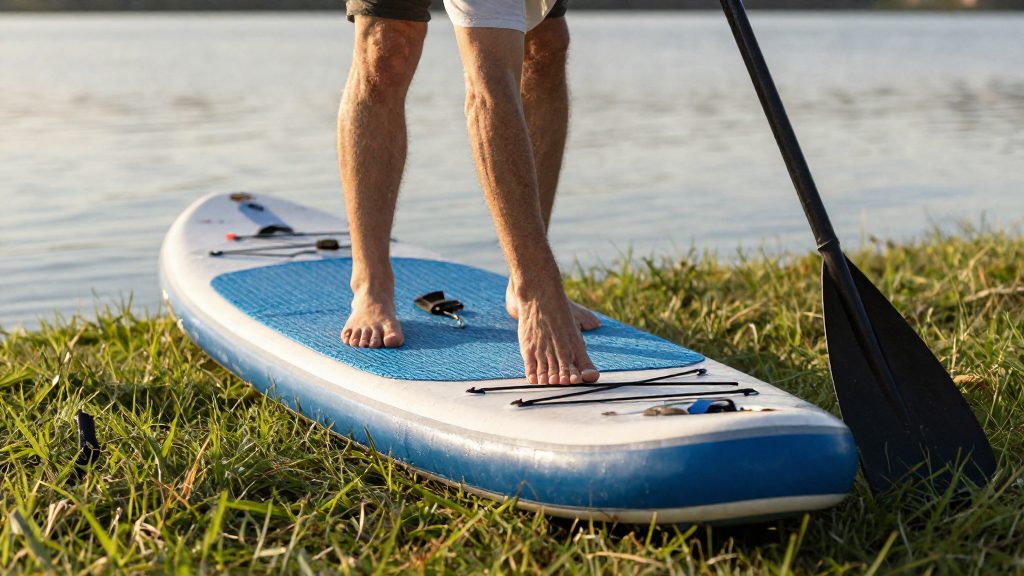
How do you calculate the capacity you need?
Start with the actual weight going onto the board:
Total onboard load = dressed paddler + carried equipment + any passenger or pet.
Weigh your packed dry bag rather than estimating it from an empty bag. Include drinking water, footwear, fishing equipment, and accessories you attach to the deck. Use the manufacturer’s definition of capacity, particularly when it distinguishes recommended rider weight from maximum payload.
Leave room for useful performance. One manufacturer’s board-selection guidance recommends moving to the next available size when total onboard weight comes within 50 lb of maximum capacity. That is manufacturer-specific performance advice, not an industry-wide safety threshold.
For a board you are considering, ask the manufacturer whether its rating represents a comfortable beginner load or the maximum load it can support. Give customer support your complete load, experience level, and intended activity so the answer applies to your situation.
Do not interpret unused capacity as automatic permission to add another person. The deck arrangement, designated rider count, and handling also need to suit that use. If your regular outings involve company or substantial cargo, evaluate a board designed around that requirement from the outset.
Why do width, length, and construction matter differently?
Width and outline determine how the platform feels
Width influences resistance to side-to-side tipping. However, the outline matters too: a board with a broad nose and tail offers a different platform from a sharply tapered board with the same maximum width. The manufacturer’s beginner guide specifically recommends wider all-around outlines for learning.
Look at the usable standing area, not just the widest measurement. You should be able to stand naturally and reach the water with your paddle without repeatedly leaning sideways.
Length changes maneuverability and travel
Longer boards generally favor efficient forward travel, while shorter boards are easier to maneuver. The manufacturer’s sizing guide, published in 2019, describes these tradeoffs. For recreational use, judge length against your route: frequent turns around a sheltered cove place different demands on a board than sustained paddling across open flatwater.
Thickness and volume need context
Volume describes the space a board occupies and helps explain its flotation. Thickness contributes to that volume, but dimensions alone do not describe how an inflatable resists bending under its rider.
Compare the complete construction and the manufacturer’s rider guidance. Avoid choosing an inflatable solely because it looks thick, or rejecting a properly rated rigid board because its profile is thinner. Treat volume as supporting information alongside the board’s intended use and load rating.
Should you choose an inflatable or a hard board?
Choose between these constructions by considering what happens before and after paddling. The manufacturer’s equipment FAQ identifies storage, transportation, travel, activity, and paddling environment as relevant factors.
| Practical consideration | Inflatable | Hard board |
|---|---|---|
| Storage | Can be deflated and packed | Needs space for its full length |
| Setup | Requires inflation and assembly | Avoids the inflation step |
| Vehicle transport | Can travel packed inside a suitable vehicle | Requires a suitable carrying arrangement |
| Handling before launch | Consider the packed kit as well as the board | Check whether you can lift and carry the full board |
Before choosing, measure the storage route through doors or stairs and consider the walk from parking to the launch. Try the carry handle with the board lifted clear of the ground. A comfortable paddling platform still needs to be manageable on land.
For an inflatable, identify the operating pressure in that model’s current instructions. Use a compatible pump and gauge, and distinguish the recommended operating pressure from any stated maximum. Follow its heat and storage precautions as well; pressure guidance for another model is not a substitute. The manufacturer’s inflation instructions illustrate why setup belongs to the individual board.
When should your activity change the choice?
Touring: assess straight-line control
For longer recreational outings, evaluate tracking: how readily the board maintains its direction between paddle strokes. A longer shape may suit this task, but you also need to turn it and control it at your destination. The manufacturer’s activity-based sizing guidance connects intended use with board selection.
Test the proposed touring board on a route resembling your normal outing. Choosing an efficient shape is useful only if you can handle it confidently when returning tired.
SUP yoga: inspect the deck
For yoga, examine the length and placement of the traction pad, along with handles and fittings that could sit beneath your hands, knees, or torso. The manufacturer’s SUP yoga guide, published in 2019, identifies wider platforms and longer deck pads as relevant features.
Check that your intended movements fit within the usable surface. A nominal width measurement cannot show whether deck hardware interrupts that space.
Fishing: plan equipment placement
Fishing introduces reaching, turning, and equipment handling. Before purchasing, sketch where the tackle, rod holders, and other accessories will go. Preserve a clear standing area and access to your safety equipment.
Confirm that the board accepts the mounting systems you intend to use. An attachment point is not permission to fit any accessory; follow the board and accessory manufacturers’ compatibility instructions. The manufacturer’s fishing-selection advice also makes transportation and fishing environment part of the decision.
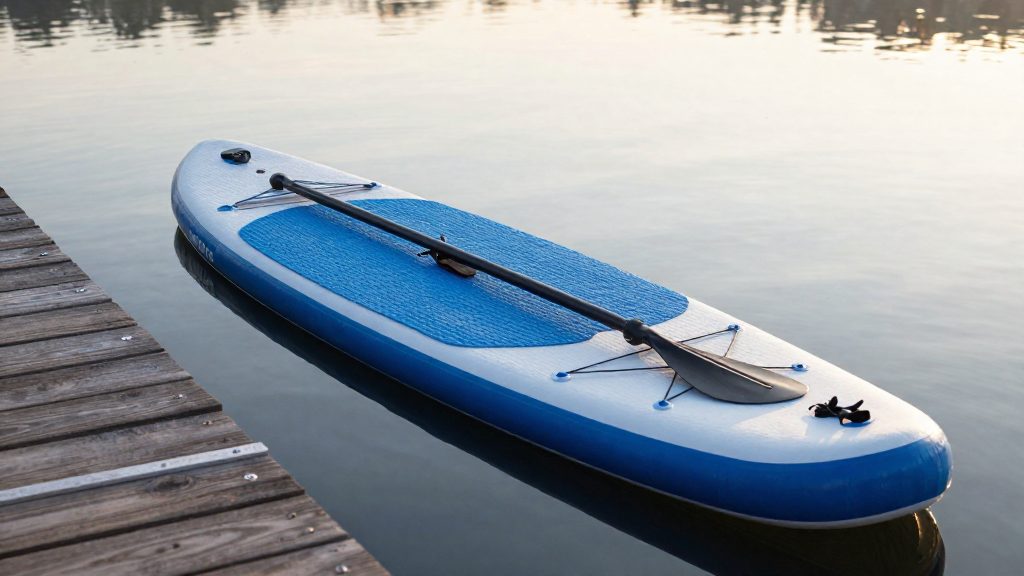
How can you check the fit during a supervised demo?
A rental session or supervised demonstration can reveal whether a promising specification works for your body and skills. Ask the instructor to assess the following tasks, rather than judging the board only while standing still:
- Launch: Begin kneeling, with enough clearance beneath the fin to avoid striking the bottom.
- Stand: Move into your standing position with your feet parallel and your weight centered.
- Paddle: Reach the water comfortably on either side without an exaggerated sideways lean.
- Control: Demonstrate forward movement, a controlled turn, and a stop.
- Recover: With instruction and suitable conditions, practice getting back aboard after entering the water.
The manufacturer’s beginner instruction guide covers launching, standing, and basic control. Ask the instructor to distinguish a technique problem from a board that feels unsuitable for you.
Pay attention to what requires constant effort. Repeatedly adjusting your stance, struggling to reach past the rails, or being unable to turn comfortably are useful observations to discuss. If you cannot reboard during supported practice, continue instruction before attempting an independent outing.
What conditions make the first outing appropriate?
Use sheltered, calm water and a straightforward landing place for your first independent session. Check the forecast for the paddling location and watch for changing conditions. The Pennsylvania Fish and Boat Commission’s paddlesports guidance emphasizes weather awareness and staying within your skills.
Wear a properly fitted, U.S. Coast Guard-approved life jacket and carry a whistle. The U.S. Coast Guard treats a SUP as a vessel beyond the narrow limits of swimming, surfing, or bathing areas, where life-jacket carriage requirements apply. Check your state and local boating requirements before launching.
Choose a leash appropriate to the water. Moving-water entrapment requires particular care: the American Canoe Association’s SUP leash guidance describes snagging hazards and waist-mounted quick-release systems. Get instruction before paddling where current or obstacles introduce that risk.
Dress for immersion rather than the afternoon air temperature. The National Weather Service warns that cold-water shock can disrupt breathing even in confident swimmers. Select suitable immersion protection for the water conditions, and leave your route and expected return with a responsible person.
Frequently asked questions
Does a recreational paddle board need registration?
Check the boating authority for the state and waterway where you will paddle. Registration and launch requirements depend on the jurisdiction and equipment configuration. The U.S. Coast Guard directs boaters to state authorities for applicable boating laws.
Will a paddle come with the board?
Check the exact package contents before ordering. Packages differ, and a board listing does not guarantee that every accessory is included. The manufacturer’s package FAQ recommends checking the individual product listing.
Can I replace the supplied fin with a shorter one?
Only use a replacement compatible with the board’s fin box and manufacturer guidance. Compatibility varies between constructions and models; the manufacturer’s fin FAQ gives model-specific restrictions.